
Updated September 23, 2025
Home Theatre Design Ideas & Games Room Inspiration in Markham and York Region
- 🎥 Practical home theatre design ideas tailored for Markham & York Region—lighting, seating, acoustics, and smart controls.
- 🧩 Ten focused sections with clear “Q&A” headings for fast answers and AI-friendly summaries.
- 🏠 Value-focused upgrades: hybrid theatre + games room layouts, local permit guidance, and budget ranges.
Thinking about turning your basement into something extraordinary? With the right home theatre design and a smart games room layout, your lower level can become the destination for family nights, entertaining friends, and quiet downtime. Below, we answer the most common questions we hear from homeowners in Markham, Richmond Hill, Vaughan, and York Region—so you can plan with confidence and enjoy results that look stunning and work flawlessly.
Request a Free Basement Theatre Estimate (Markham)
Why convert a basement into a home theatre?
Basements naturally control light and sound, which makes them ideal for a private cinema. Because they’re tucked away from main living areas, you’ll reduce noise transfer, improve immersion, and keep everyday spaces clutter-free. In addition, finished basements typically increase resale appeal across York Region. That means a well-planned theatre can deliver comfort now and long-term value later. To start, define your primary use: movie marathons, sports nights, gaming sessions, or a hybrid of all three. Then, size seating and screen distance around that goal for an experience that feels intentional and polished.
Do you need permits or approvals in Markham?
In most cases, yes—especially if you’re adding or relocating electrical, framing new partitions, moving HVAC, or improving sound isolation. Markham building permits ensure safety and code compliance; they also prevent costly rework later. As a rule of thumb, plan to verify structure, grading, and energy compliance up front. We coordinate with the City of Markham, prepare drawings, and schedule required inspections so your project moves smoothly from design to completion. If you’re unsure whether your scope needs a permit, ask us to review your plan before you purchase equipment or begin demolition.
How should you plan the layout and seating?
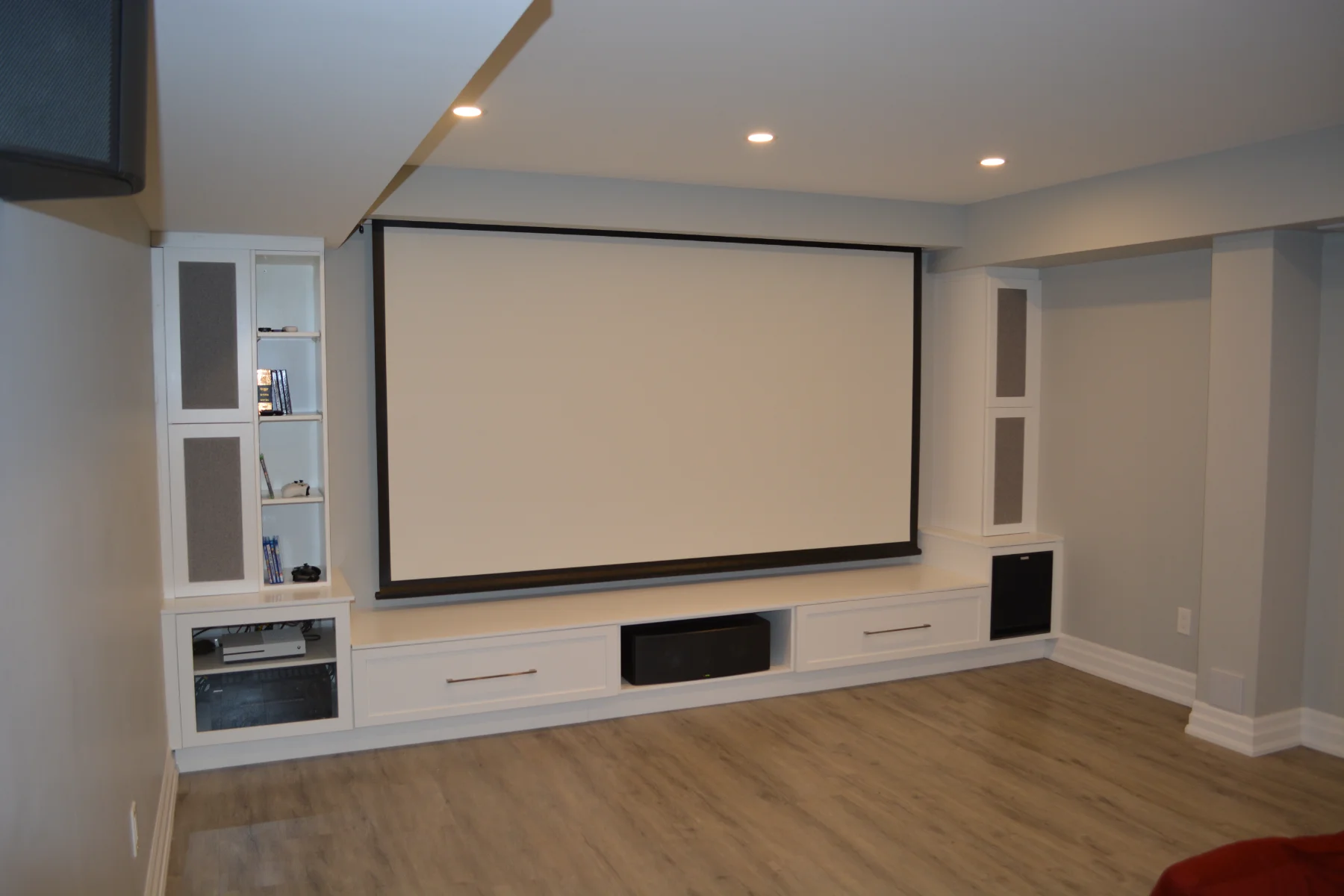
Layout begins with sight lines and screen size. First, choose your primary viewing position and calculate the optimal screen width (typically 0.84–1.0× the viewing distance). Next, map seating in one or two rows; when space allows, add a rear riser for a clear view over the front row. Provide at least 90 cm (36″) for walkways and 45–60 cm (18–24″) between reclined seats. If you prefer a lounge feel, a sectional with chaise can be a smart alternative. Finally, plan where doors swing and where subwoofers will sit so equipment, comfort, and circulation all work together.
What lighting works best for a home theatre?
Layered, dimmable lighting preserves contrast on screen while keeping the room safe and comfortable. Use recessed cans on a dimmer for general light, low-glare wall sconces for ambience, and LED strip or step lights for safe movement during a film. In the games zone, add task lighting over tables and shelving. For convenience, connect scenes (“Movie,” “Intermission,” “Cleanup”) to a smart hub so levels adjust with one tap or voice command. As a simple rule, keep lighting warm and indirect in the theatre area to minimize reflections and maximize immersion.
How do you handle soundproofing and acoustics?
Great audio depends on two things: keeping outside noise out and tuning reflections inside. To contain sound, consider double 5/8″ drywall with damping compound, sealed outlets, and insulated joist bays. Inside the room, blend absorption (acoustic panels, carpet, upholstered seating) with diffusion (bookshelves, slatted wood features) to prevent echoes and dead spots. For speaker placement and listening angles, follow established best practices so dialog stays crisp and bass remains tight throughout the room. If you share walls with neighbours or have bedrooms above, prioritize ceiling isolation early in design for best results.
What wiring and smart tech do you need?
Plan infrastructure before drywall. Run dedicated 20-amp circuits for amplifiers, pull in-wall rated HDMI and Ethernet to the projector and equipment rack, and add spare conduit for future upgrades. Hardwire streaming where possible to avoid Wi-Fi hiccups during big games or movie nights. Then, unify everything with a smart control system so lights, audio, projector, and motorized shades work from a single remote or app. Because technology evolves, label every run, keep a photo log of walls before closing, and leave accessible pathways for the next generation of gear.
How much does a home theatre cost in Markham?
Budgets vary by size, finish level, and equipment. As a practical guide, an entry setup with a quality projector, screen, soundbar or compact surround, and lounge seating typically starts around $5,000–$10,000. A mid-range room with custom riser, 5.1 or 7.1 surround, acoustic treatments, and dimmable lighting often lands in the $15,000–$25,000 range. Premium builds with 4K laser projectors, reference-grade audio, and advanced isolation usually exceed $30,000. If you’re adding a games area (pool, foosball, arcade), plan an additional $3,000–$10,000 depending on selections.
Can you combine a games room and theatre?
Absolutely. Many Markham homeowners prefer a hybrid space that shifts from movie mode to game night seamlessly. Divide zones visually—use darker finishes and curtains around the screen wall, then brighter materials and task lighting in the games area. Place noisy items (arcade machines, air hockey) farther from the screen to reduce vibration and light spill. If space is tight, choose multi-use furniture: nesting tables, storage benches, and a compact bar with integrated glassware. Done well, you’ll enjoy a single cohesive room that supports movie marathons, casual hangs, and weekend tournaments.
What are real examples of local projects?
Here are a few favourites. In Cornell (Markham), we converted a guest room into a 5.1 theatre with a star-ceiling and acoustic wall panels. In Maple, a karaoke nook sits behind velvet drapery so it disappears during films. In Thornhill, we delivered a hybrid space—poker table, display shelving, and a cosy two-row cinema. Clients repeatedly tell us the new rooms bring everyone together more often and make hosting easy. When you’re ready, we’ll help you prioritize impact, sequence the work, and select finishes that suit your lifestyle and budget.
How do you maintain and upgrade over time?
To keep performance high, dust vents and filters seasonally, recalibrate audio annually, and update streaming hardware every 4–5 years. Projectors typically see meaningful leaps every 7–10 years; seating and carpet benefit from a refresh around the 8-year mark. Because wiring is the backbone, protecting conduit paths now makes future upgrades simple and cost-effective. Keep a small maintenance kit—spare batteries, microfiber cloths, labelled cables—and store manuals digitally so troubleshooting stays painless.
DIY vs. Professional Installation: What’s the Difference?
| Feature | DIY | Professional |
|---|---|---|
| Cost | Lower upfront | Higher upfront, fewer do-overs |
| Quality/Calibration | Inconsistent | Reference-grade setup |
| Soundproofing | Limited options | Engineered assemblies |
| Timeline | Variable | Scheduled completion |
Related resources:
Frequently Asked Questions
What’s the difference between 5.1 and 7.1 surround?
Both deliver immersive audio, but 7.1 adds two rear channels for a fuller, more precise sound field. If your room supports it, 7.1 improves rear imaging; otherwise, a well-tuned 5.1 can sound excellent and may be more cost-effective.
Can I build a theatre in a small basement?
Yes. With thoughtful screen sizing, a single row of seats, and darker finishes, even 230–280 sq ft can feel cinematic. Consider a short-throw projector, low-profile speakers, and storage benches to maximize space without sacrificing experience.
Do home theatres increase property value?
Generally, yes—especially across York Region where finished basements are highly desirable. While exact ROI varies, buyers often view a dedicated theatre or hybrid games space as a premium amenity that differentiates your home.
Further reading: Surround placement and room setup best practices are widely documented by industry leaders. Explore guidance from Dolby and professional integrator organizations for deeper technical detail.
Book Your Free Home Theatre Design Consultation (Markham & York Region)
Written by Teresa Spagnolo, Design Consultant at Nova Decor Construction Ltd.